
The 3-hour problem: How Indian doctors lose half their day to a pen
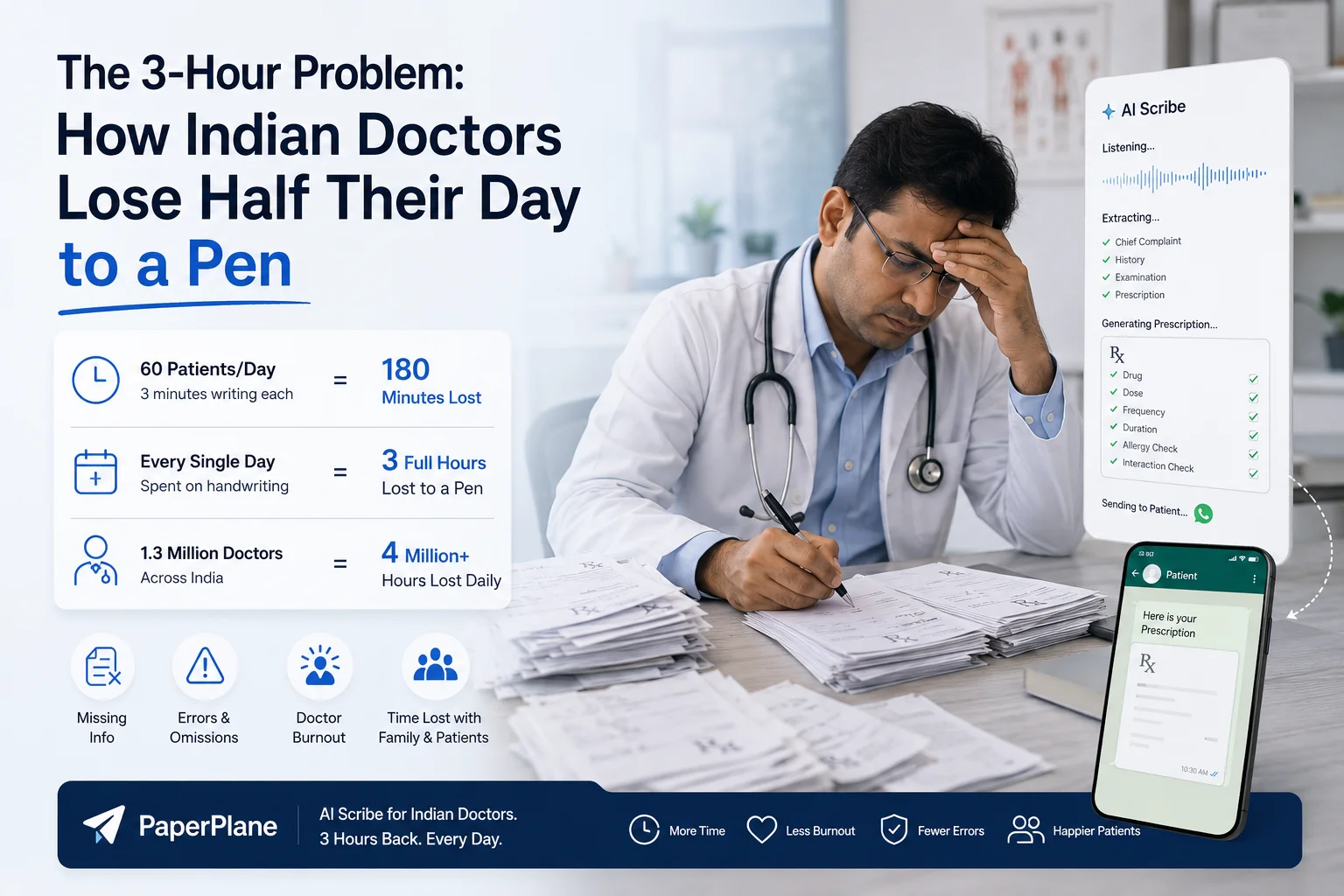
60 patients × 3 minutes per prescription = 3 hours every clinical day spent writing instead of practising medicine. Here's why that number became the founding insight behind PaperPlane.

Ask any Indian general physician what consumes the most time in their day, and you’ll get the same answer almost word-for-word: writing.
Not diagnosing. Not consulting. Not even the long tail of administrative work most clinics still run on paper. Writing — the act of physically putting pen to a prescription pad — is the single largest time sink in Indian primary care. We knew this anecdotally. Then we did the math, and the number stopped us cold.
The math
A typical Indian OPD doctor sees 60 patients a day. Each handwritten prescription takes around 3 minutes to draft, double-check, and hand over. The arithmetic is mechanical:
60 patients × 3 minutes = 180 minutes — three full hours, every single day, spent on a piece of paper that the patient will probably lose, the chemist will probably misread, and no clinical-research database will ever see.
That’s 37% of an 8-hour clinical day. More than a third of every shift, given over not to medicine but to a fountain pen. Across 1.3 million doctors in India, that’s the equivalent of roughly four million working hours lost to handwriting every single day.
The downstream cost is worse than the time
If the only cost were time, we could shrug it off as inefficient but functional. The real cost is what handwritten prescriptions miss.
In 2016, Joshi et al. published a study in the Journal of Clinical & Diagnostic Research analysing 549 handwritten prescriptions from an OPD setting in Gujarat. They identified 13,334 separate errors and omissions. The pattern is staggering:
- Patient age was missing in 74.5% of prescriptions.
- Drug dose was specified in only 47%.
- Allergy history was recorded in 0%. Not a single prescription out of 549.
These aren’t sloppy outliers. These are the conditions under which most of India’s outpatient medicine is practised today — because the doctor doing the prescribing is also exhausted, time-pressed, and physically writing while the next patient is already at the door.
Burnout is the silent half of the equation
The 3-hour problem doesn’t only consume time. It quietly consumes the doctor.
A 2024 PMC/JAMA study tracking 263 physicians across 6 health systems found that, before the introduction of an ambient AI scribe, 51.9% of doctors were experiencing burnout. After 30 days with the scribe in place, that number dropped to 38.8%. Self-reported cognitive load fell by 24 points. The doctors weren’t just saving time — they were getting their attention, their patience, and their professional purpose back.
Why this became PaperPlane’s founding insight
When we sat down to build PaperPlane, the temptation was to do what nearly every clinical software company does: build an EMR. Build a comprehensive system. Cover everything. Solve the whole problem in one go.
The 3-hour number stopped us from doing that. The 3-hour problem is not an EMR problem. It is not an administrative-workflow problem. It is not even a digitisation problem. It is a writing problem.
So we didn’t build an EMR. We built an ambient AI scribe that listens to the doctor-patient conversation in any language, structures a complete prescription — drug, dose, frequency, duration, allergy and interaction checks — and delivers it to the patient’s WhatsApp before the stethoscope is back in the pocket. The doctor’s role becomes review, not write. Three hours of writing become fifteen minutes of glancing at a draft and tapping Send.
What “three hours back” actually means
The first cohort of Indian doctors who switched to PaperPlane’s scribe started reporting the same thing within two weeks of installation. We started cataloguing the reactions:
- “I leave at 7, not 9.” The most common quote we hear. The three hours are not theoretical — they show up as two extra hours at home.
- “I see one or two more patients a day.” When the bottleneck is no longer the doctor’s hand, the bottleneck shifts to clinic capacity.
- “The drug-interaction catches feel almost embarrassing.” When you stop writing, you start seeing what the AI catches — and how much you used to miss at the end of a 70-patient day.
- “My patients get a clean Rx on WhatsApp.” Compliance goes up. Pharmacist misreads go down. The chemist no longer has to phone the clinic to decipher a scrawl.
The bigger thesis
The 3-hour problem matters not only because of what it costs individual doctors, but because of what it implies about where the largest improvement in Indian healthcare can actually come from.
India has roughly 1 million private clinics. 98% of them are still paper-based. They are not waiting for a better EMR — they have ignored every EMR for two decades. They are waiting for something that disappears into the background of their existing workflow and gives them three hours back. That is the product. That is the bet.
If you’re a doctor who has read this far, you already know which three hours we’re talking about. Read our story, or book a free demo — we’ll show you exactly what those three hours look like when an AI is doing the writing for you.